
In October 2025, I was privileged to attend the 36th Field Runologists Meeting, hosted on the Orkney Islands. The purpose of this annual meeting is simple yet important: to bring runologists together to study and discuss runic inscriptions through direct, hands-on examination. This meeting would focus on the inscriptions found on the Orkney Islands, of which there are around fifty-odd inscriptions. Most of these runic inscriptions have been published in The Runic Inscriptions of Maeshowe, Orkney (1994) by Michael P Barnes and The Scandinavian Runic Inscriptions of Britain (1996) by Barnes and R I Page. Nonetheless, due to more recent runic finds coming to light as well as the need for revision of some previous interpretations, Judith Jesch and I will collaborate on an article which hopes to re-evaluate the Orkney runic corpus. Hosting a field runologist meeting in the Orkney Islands meant that experienced field runologists could come together to assess the inscriptions and provide connections to inscriptions from other areas, such as Scandinavia.
We began the first day in a lecture room at the University of the Highlands and Islands’ Orkney College. The team from Orkney Museum had transported a selection of inscriptions for us to examine. These included runic inscriptions on a variety of objects, all catalogued with Signum numbers such as Or 1, Or 10, Or 15, for example, with Or indicating their Orkney findspot. One of the highlights for me was Or 15, also known as Orphir II (see image below). It is a rib bone bearing an inscription that declares “this bone was…”. The object was discovered during excavations at Orphir, a site associated with the Orkneyinga Saga and Earl Paul’s Yule feast of 1136. Perhaps it was carved post-meal, where the rib meat was eaten by a rune-carver who then used the now-clean bone as their writing surface of choice. The inscription’s explicit reference to the object itself makes it particularly compelling to me, given my research interest in the relationship between runic inscriptions’ functions and the objects on which they are carved. Indeed, what could the function of Or 15 be, if it was carved after dinner on food waste, and then deposited with the rest of the scraps? Not all runic inscriptions were designed as monuments to great deeds, as Or 15 clearly shows! In the afternoon, we departed Kirkwall for Breckness and also visited the Bay of Skaill. Snacks from Argo’s Bakery (the best in Kirkwall!) and a little whisky were enjoyed while taking in views across the bay. The day concluded with a Rune Relay held at the St Magnus Centre in Kirkwall, where runologists each presented a favourite inscription to an audience of fellow scholars and members of the public.
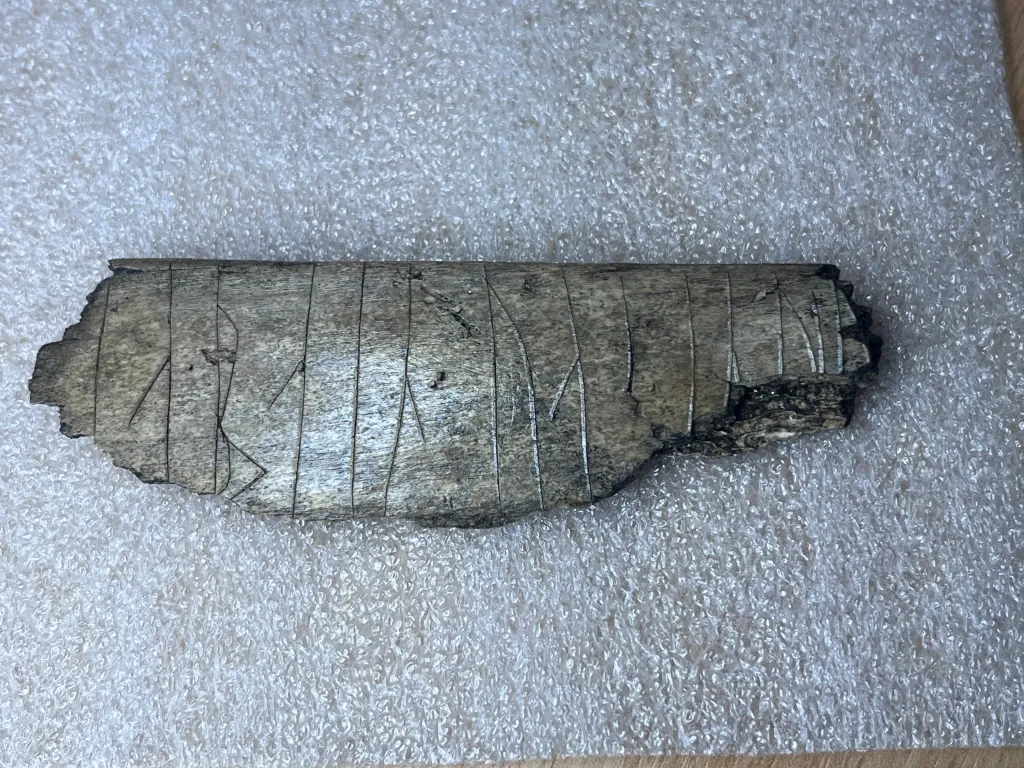
‘Or 15’ (Photo by Jasmin Higgs)
The second day began early with a site visit to Orphir, guided by the knowledgeable Colleen Batey, after which we divided into two groups to explore different locations. One group visited Maeshowe, where special permission allowed us extended time inside the chamber to photograph and study its runic inscriptions, while the other group went to the Ring of Brodgar before the groups swapped. At Maeshowe, I was particularly intrigued by Or Barnes 20 (see below). This inscription begins with twig runes, a cryptographic form of runic writing, before turning to more standard younger futhark runes, and states: “That man who is most rune-skilled west of the sea carved these runes with that axe which Gaukr Trandill’s son owned in the south of the country.” I enjoyed musing over the fact that, though we would never know whether this anonymous person was the best rune-carver, we are still deciphering their twig-runes and reading their inscription. After returning to Kirkwall, the day ended with a community dinner at the Town Hall.

‘Or Barnes 20’ (photo by Jasmin Higgs)
On our final half-day, we reconvened at UHI to review the inscriptions we had studied and to discuss new readings. This was followed by presentations on recent finds from Norway and Sweden, a reintroduction to Runor, an online database of Old Norse runic inscriptions, and the launch of a new collaborative initiative, The Runic Post, which aims to share new runic discoveries with a wider audience.
During this trip, I was able to view many of the Orkney runic inscriptions and make my own readings, which will contribute to my upcoming research with Judith Jesch. I would like to thank the Scottish Society for Northern Studies for providing me with this fantastic opportunity.
– Barnes, Michael P. (1994), The Runic Inscriptions of Maeshowe, Orkney. Uppsala.
– Barnes, Michael P. and R. I. Page (2006), The Scandinavian Runic Inscriptions of Britain. Uppsala.
- Dr Jasmin Higgs (University of Nottingham)