
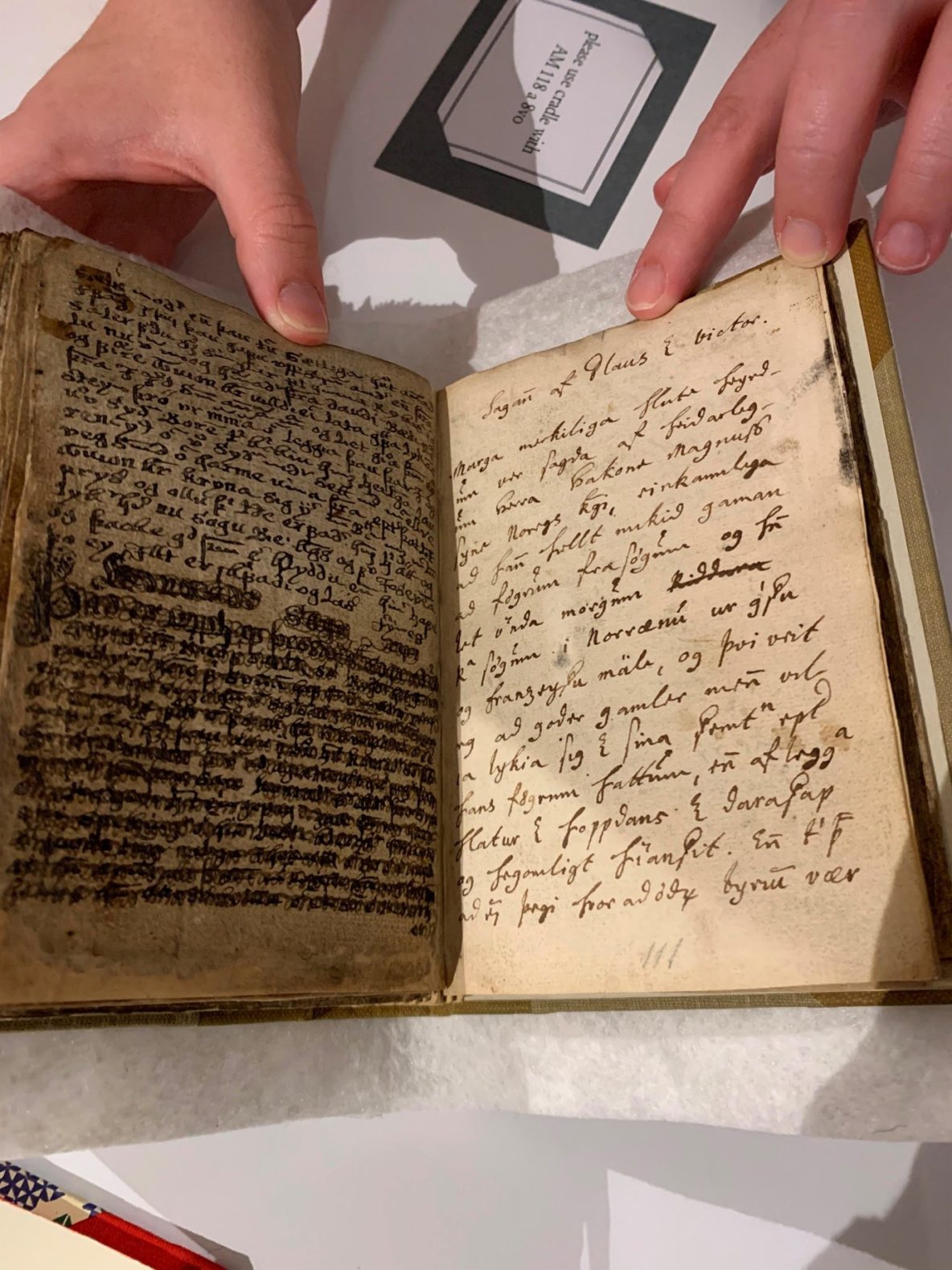
From 15th-25th June 2026, I attended the Summer School in Scandinavian Manuscript Studies Advanced Level course at the Árni Magnússon Institute in Reykjavík. The Summer School is a collaboration between the Árni Magnússon Institute for Icelandic Studies, the University of Iceland, the University of Copenhagen and the National and University Library of Iceland. I previously attended in 2024 on the Basic level, and returned this year with help from a Postgraduate/Early Career Research Grant from the SSNS.
Over the course of ten days, we engaged in a variety of topics, including medieval palaeography, advanced codicology, textual criticism, stemmatology, fragmentology, paper history, and more. This year was the first year to hold sessions on ‘Non-invasive analysis of medieval pigments’, where we saw how FORS and XRS systems are used to analyse the pigments and dyes found in medieval illuminations. I have been keen to develop my skills with digital tools for manuscripts and edition-making, and this course providing a strong foundation in training. After a taster session in XML in 2024, this time around we dug deeper into the system, to both transcribe manuscripts and to catalogue materials at the National Library. On the Saturday, we had an entire day on Digital Tools, where we learned about programmes such as eScriptorium and Transkribus, both of which I hope will prove useful in future research.
There were also opportunities for fun and creative learning on this trip as well. On the Sunday, we took an excursion to Snæfellsnes to visit places like Helgafell and the Berserkjagata. As I focused on Eyrbyggja saga in my MPhil, it was fantastic to actually see the area in-person and get a feel of what it would have been like in the medieval period (and why it seems that the peninsula has so much undead activity)! We also had several workshops where we got to make our own paper, write with a quill on vellum, pour a paper seal, and sew our own quires together into a little notebook. It’s sessions like these that add so much to the summer school, and that really help to exemplify how much work goes into producing the manuscripts that we see in the reading room or the archives.
Through this Advanced course, I have strengthened skills and developed new ones, and have taken with me a greater interest in the digital tools available in Old Norse studies and the importance of manuscripts even for saga scholars like me. It is always a wonderful time where I meet my fellow Old Norse scholars and learn so much. I hope to continue next year into the Masters’ course in Copenhagen and complete all three levels of the course. I would like to thank again the society for their generous grant, which allowed me to pay for the tuition to the summer school this year.